

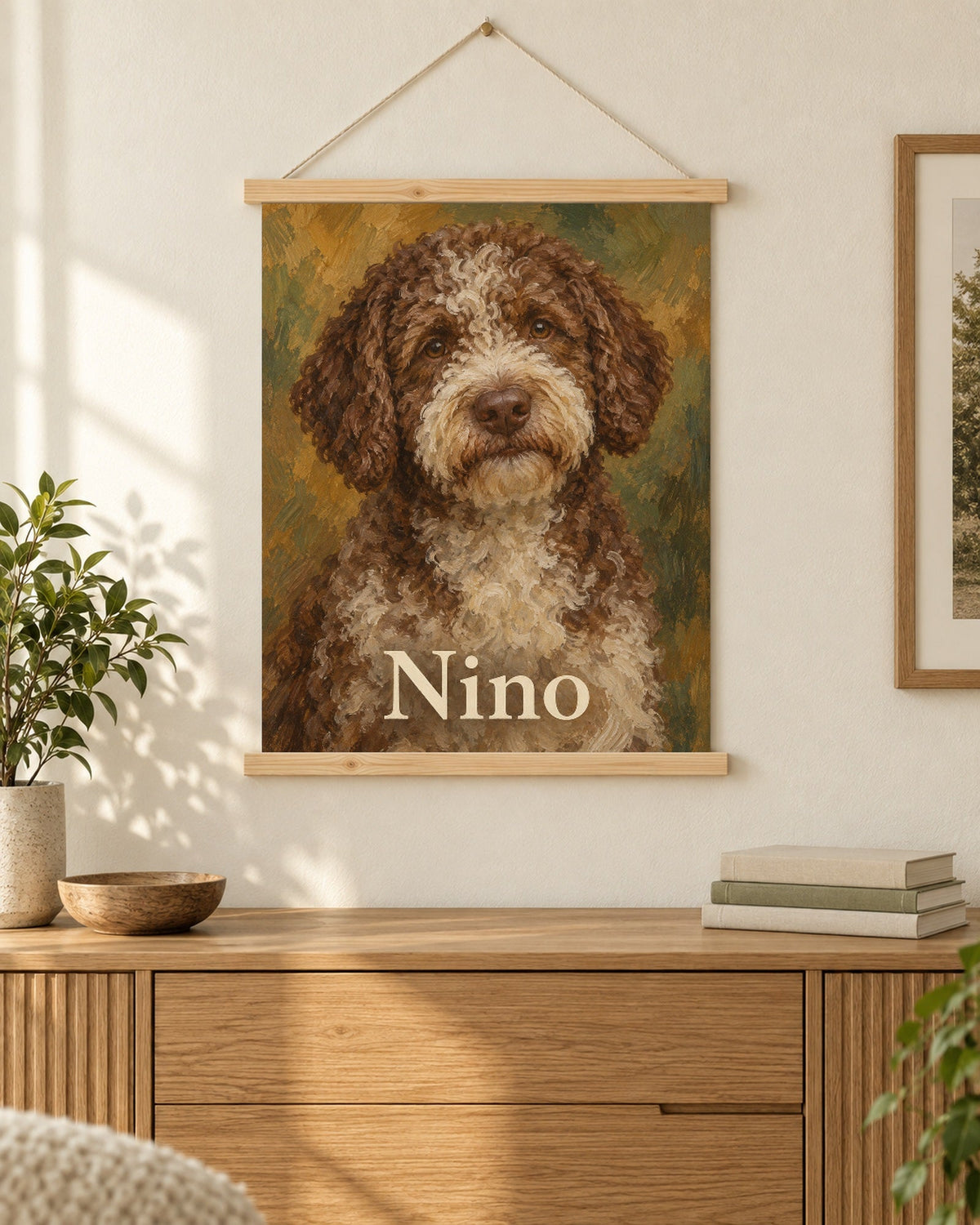
It changed jobs because its water disappeared. In the marshes around Comacchio and Ravenna, the Lagotto Romagnolo once retrieved waterfowl. When the wetlands were drained for farmland, it used its nose to find something else: truffles. Today, the FCI standard explicitly calls it a truffle dog.
| FCI | Group 8 (Retrievers, Flushing Dogs and Water Dogs), Section 3 Water Dogs, Standard No. 298, working trial optional |
|---|---|
| Country of origin | Italy |
| Size (height at the withers) | Males 43 to 48 cm, females 41 to 46 cm, tolerance plus or minus 1 cm |
| Weight | Males 13 to 16 kg, females 11 to 14 kg |
| Life expectancy | no reliable study figure found (N/A) |
| Coat | woolly, somewhat rough on the surface, tight ring-shaped curls with visible, waterproof undercoat |
| Colours in the standard | solid off-white, white with brown or orange patches, orange roan and brown roan, brown in various shades (including sable) or orange, each with or without white; brown mask and tan markings allowed; no black |
Origins
The FCI definitively recognised it in 2005. A revised standard took effect in September 2026; the English version dates from 2 October 2026. Size, weight and colours remain the same; changes chiefly concern more precise proportions and shorter clipping requirements. The 2019 German translation is therefore outdated.
Temperament
According to the standard, it is obedient, undemanding, alert, affectionate, very attached to its owner and easy to train, as well as an excellent companion and watchdog. Selection modified its former hunting instinct so game scents would not distract it when searching for truffles. In daily life, this means it reliably announces visitors but usually responds well to you.
Exercise and activities
Its strength is its nose. Search games, mantrailing or proper truffle courses challenge it more than running alone. Around an hour and a half of daily exercise, some involving mental work, makes it a balanced companion. It still enjoys water.
Grooming
The curly coat sheds little but mats as it keeps growing. The standard requires regular removal of mats and limits clipped coat length to two to three centimetres. It must explicitly not be blow-dried into a fluffy shape like a Poodle . Plan weekly brushing and clipping several times a year.
Health
In Swedish X-ray screening of 2.448 young Lagotti, 30,1 per cent had hip dysplasia of grade C or above (Engdahl et al. 2026). Two inherited diseases are characteristic of the breed. In benign familial juvenile epilepsy, seizures begin at 5 to 9 weeks and usually stop by the 13th week (Jokinen et al. 2007). A nervous-system storage disease causing progressive unsteadiness is linked to an ATG4D gene change, for which a genetic test exists (Kyöstilä et al. 2015). Ask for the parents’ hip results and genetic tests.
Who suits the Lagotto Romagnolo?
Families and first-time owners who enjoy working with their dog outdoors and schedule grooming as a regular commitment.
Who is less suited?
People unwilling to brush a dog, and anyone seeking a quiet dog that does not announce arrivals.

The breed quiz helps you decide whether a curly dog with a keen nose suits you; our book offers more detailed guidance: “Welcher Hund passt WIRKLICH zu dir?” (book in German). For the first weeks with a puppy, there is the free Puppy Starter Pack. Find wall art of your Lagotto among our dog portraits from your own photo or as a poster in a wooden frame.
Further reading
- Poodle: why the Doodle only promises what it already does
- Beagle: a nose with a dog attached, and what that means daily
- Puppy checklist: essentials and the first 3 days
Sources, accessed on 20.10.2026: FCI-Standard Nr. 298 Lagotto Romagnolo (fci.be, English version dated 02.10.2026, valid standard published 08.09.2026; for comparison, German version dated 11.10.2019); Engdahl K et al., Prevalence of hip and elbow dysplasia in young adult dogs in Sweden, Veterinary Record 2026; Jokinen TS et al., Benign familial juvenile epilepsy in Lagotto Romagnolo dogs, Journal of Veterinary Internal Medicine 2007; Kyöstilä K et al., A missense change in the ATG4D gene links aberrant autophagy to a neurodegenerative vacuolar storage disease, PLoS Genetics 2015.
The links to our books are affiliate links. Buying through them supports us at no extra cost to you.


