

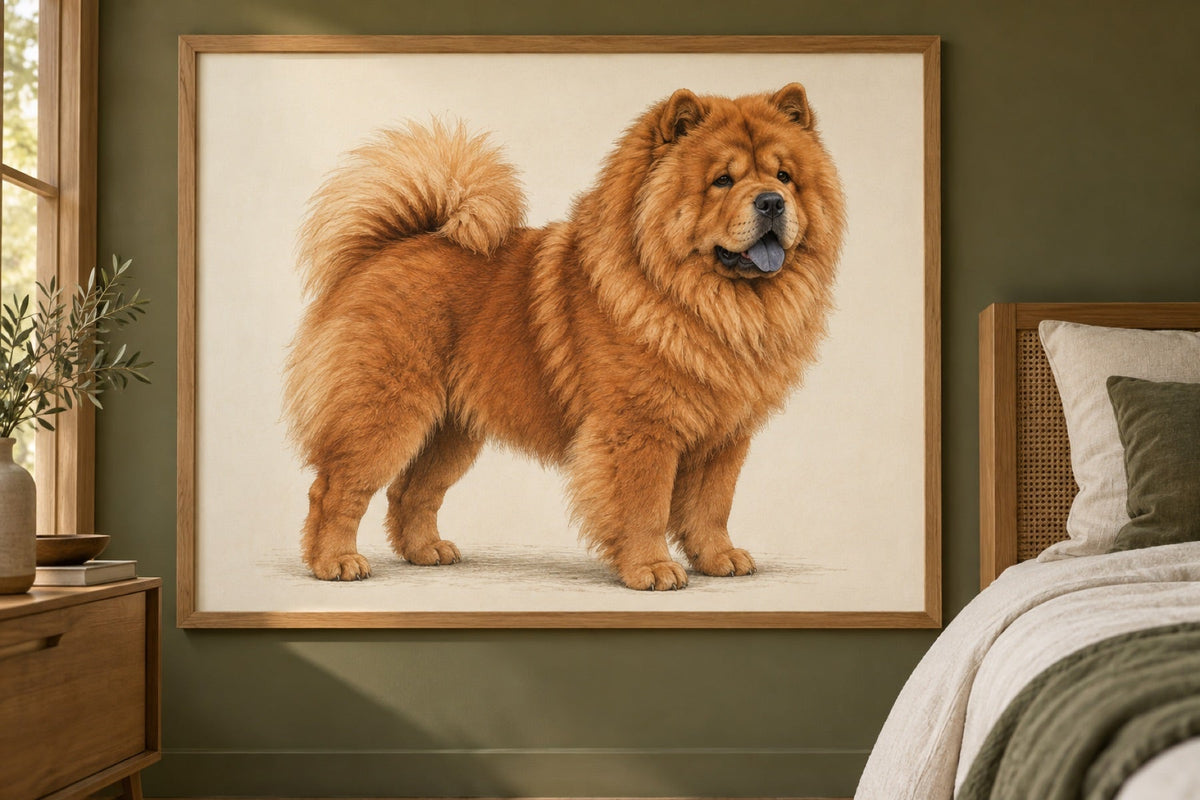
Look into a Chow Chow’s mouth and you see a blue-black tongue, described by the FCI standard as characteristic of the breed. Add a lion-like appearance, a short pendular gait and a dignified temperament more inclined to reserve than embracing every stranger.
| FCI | Group 5 (Spitz and primitive types), Section 5 Asian Spitz and related breeds, Standard No. 205, without working trial |
|---|---|
| Country of origin | China (patronage: Great Britain) |
| Size (height at the withers) | males 48 to 56 cm, females 46 to 51 cm |
| Weight | not specified in the FCI standard |
| Life expectancy | median 12.1 years in a UK analysis of 584,734 dogs (McMillan et al. 2024) |
| Coat | rough (profuse, dense, standing away from the body, with a mane) or smooth (short, dense and plush) |
| Colours in the standard | solid black, red, blue, fawn, cream or white, often shaded, never patched or particoloured |
Origins
According to the standard, the breed comes from China, where it guarded and hunted. It is said to have been known there for over 2,000 years, related to Nordic Spitz with some molosser ancestry. China’s isolation meant it appeared elsewhere only around 1800. It attracted attention in Great Britain only in the 1920s, with some shown at Crufts in 1925.
Temperament
The standard is brief: quiet, a good watchdog, independent, loyal but reserved. In daily life, closely attached to family without being intrusive, often distant with strangers. A Chow learns when the point makes sense, rather than simply to please.
Exercise and activity
A Chow needs daily walks rather than strenuous sport. The standard emphasises a short, pendular gait with good endurance. Heat quickly makes exertion difficult; schedule summer walks in cooler hours.
Grooming
The profuse rough coat needs thorough brushing down to the skin several times weekly, daily during shedding. Clipping is not a solution: the standard penalises artificial shortening that changes the natural outline, permitting trimming only on the feet.
Health
The key documented concern is eyelids. A VetCompass study of over two million dogs attending UK practices found annual entropion in 9.28 percent of Chow Chows: inward-rolling lids rubbing the cornea. Odds were 53 times higher than in crossbreeds (O’Neill et al. 2025). The standard itself requires eyes free from entropion and rejects head wrinkles. Look for breeding dogs with open, dry eyes and no tear staining.
Who is a Chow Chow right for?
Calm, experienced people who value an independent, dignified dog and have time for grooming.
Who should look elsewhere?
Families seeking a cuddly playmate for children, hot homes and anyone expecting instant obedience.

Assess whether a Chow Chow suits your routine with our breed quiz or our book “Which Dog REALLY Suits You?” (book in German). For the first weeks with a puppy, there is the free Puppy Starter Pack. If your little lion already lives with you, explore dog portraits from your own photo, also as a magazine-cover canvas.
Further reading
- Pomeranian: why you must not clip the coat
- Siberian Husky: why so many reach shelters at two years old
- Autumn shedding in dogs and cats: what is normal and when it is not
Sources, accessed on 20.10.2026: FCI Standard No. 205 Chow Chow (fci.be, English version dated 06.10.2026, no German version available); McMillan KM et al., Longevity of companion dog breeds: those at risk from early death, Scientific Reports 2024; O'Neill DG et al., Conformational eyelid disorders in dogs under primary veterinary care in the UK: epidemiology and clinical management, 2025.
Links to our books are affiliate links. Buying through them supports us at no extra cost to you.


