

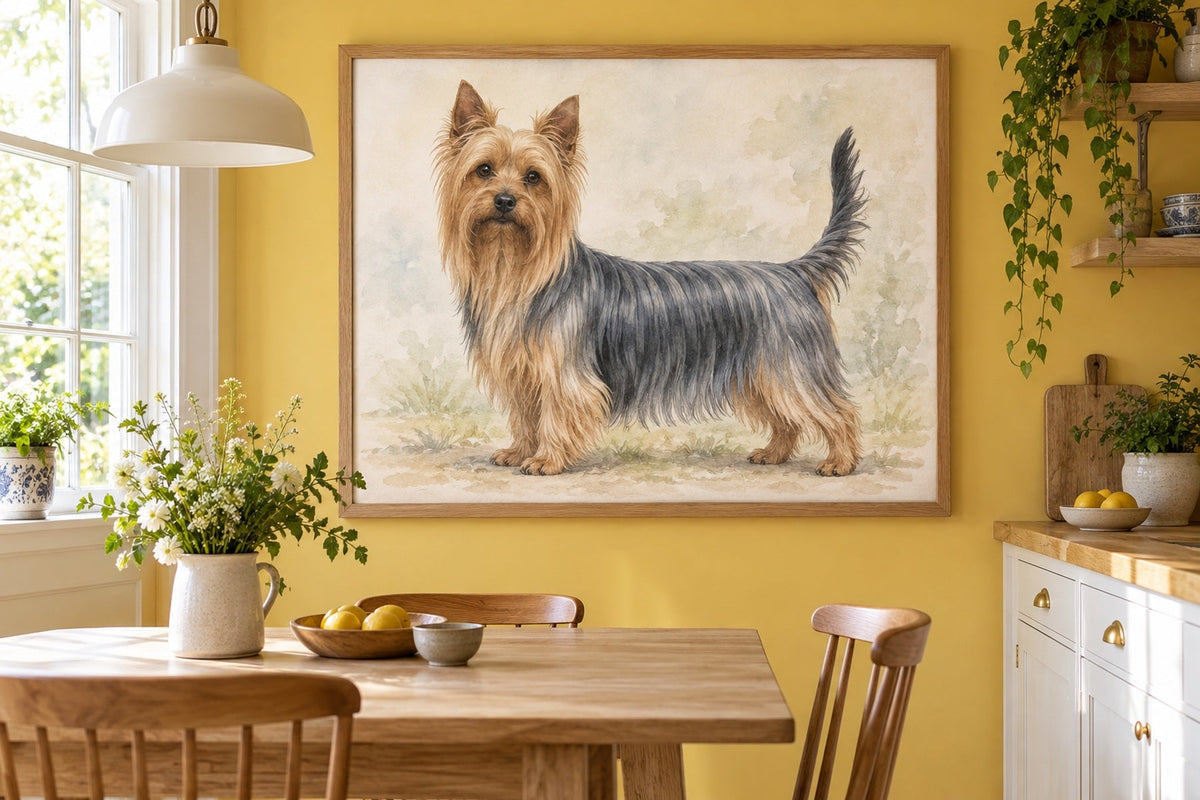
Shiny, parted silk hair, yet enough substance under the FCI standard to hunt and kill domestic rodents: the Australian Silky Terrier looks ready for a grooming salon but is a rat catcher at heart.
| FCI | Group 3 (Terriers), Section 4 Toy Terriers, Standard No. 236, without working trial |
|---|---|
| Country of origin | Australia |
| Height at the withers | Males 23 to 26 cm, females may be slightly smaller |
| Weight | Not specified in the FCI standard, only “in proportion to height at the withers” |
| Life expectancy | Median 13,3 years in a British analysis of 584.734 dogs (McMillan et al. 2024) |
| Coat | Lying flat, fine, glossy and silky; must not hinder movement, with feet free of long hair |
| Colours according to the standard | Any shade of blue and tan, the more clearly separated the better; silver and white not permitted |
From Tasmania via London to Sydney
According to the standard, the two main ancestors were the Australian Terrier and the Yorkshire Terrier. Between 1820 and 1830, a blue broken-coated terrier bitch bred in Tasmania reached England and was mated to a Dandie Dinmont. A London breeder bought puppies, later emigrated to Sydney and continued breeding with Australian and Yorkshire Terriers. The first standard appeared around 1900.
A terrier rather than a lap dog
Keen alertness, liveliness and ability, alongside courage, and unsurpassed as a companion: that is the standard’s description. In everyday life, they have their own ideas, chase mice and announce sounds. Short, varied exercises and clear rules suit them. Walks, search games and digging in the garden provide activity.
Silky hair needs routine
The hair grows long and fine, without the standard describing an undercoat. Brush several times weekly and renew the parting to prevent knots, keeping the feet short. Puppies are black; the blue must have developed by 18 months. The standard describes docked and undocked tails. In Germany, docking is generally prohibited under Section 6 of the German Animal Welfare Act. The tail therefore stays long.
Kneecaps, liver vessels and lifespan
US clinical data placed the Silky Terrier among breeds with significantly increased risk of patellar luxation, as summarised by a British VetCompass study; 5,3 per cent of related Yorkshire Terriers were affected there (O’Neill et al. 2016). In an Australian clinic, the breed was overrepresented among 233 dogs with congenital liver shunts (Hunt 2004). The median lifespan of 13,3 years rests on 105 dogs and does not differ reliably from crossbreeds.
Who will enjoy a Silky
People seeking a small, alert dog with terrier character, who enjoy grooming and want a companion happy to join longer walks.
Who should choose another breed
Anyone expecting a quiet, easy-care dog, or keeping small pets such as hamsters and mice, is unlikely to enjoy this hunting enthusiasm.

To check whether a little terrier with silky hair suits you, try the breed quiz, or explore the question further in our book “Welcher Hund passt WIRKLICH zu dir?” (book in German). If a puppy is joining you soon, there is the free Puppy Starter Pack. Capture your Silky’s blue and tan in a downloadable digital artwork or choose a wall picture among our dog portraits.
Further reading
- Yorkshire Terrier: three kilos of terrier, not an accessory
- Maltese: lovely character, full-time grooming
- Toilet training your puppy: a plan for the first 4 weeks
Sources, accessed on 20.10.2026: FCI-Standard Nr. 236 Australian Silky Terrier (fci.be, German version dated 04.02.2016; englische Originalfassung vom 05.12.2012); O'Neill DG et al., The epidemiology of patellar luxation in dogs attending primary-care veterinary practices in England, Canine Genetics and Epidemiology 2016; Hunt GB, Effect of breed on anatomy of portosystemic shunts resulting from congenital diseases in dogs and cats: a review of 242 cases, Australian Veterinary Journal 2004; McMillan KM et al., Longevity of companion dog breeds: those at risk from early death, Scientific Reports 2024.
The links to our books are affiliate links. Buying through them supports us at no extra cost to you.


