

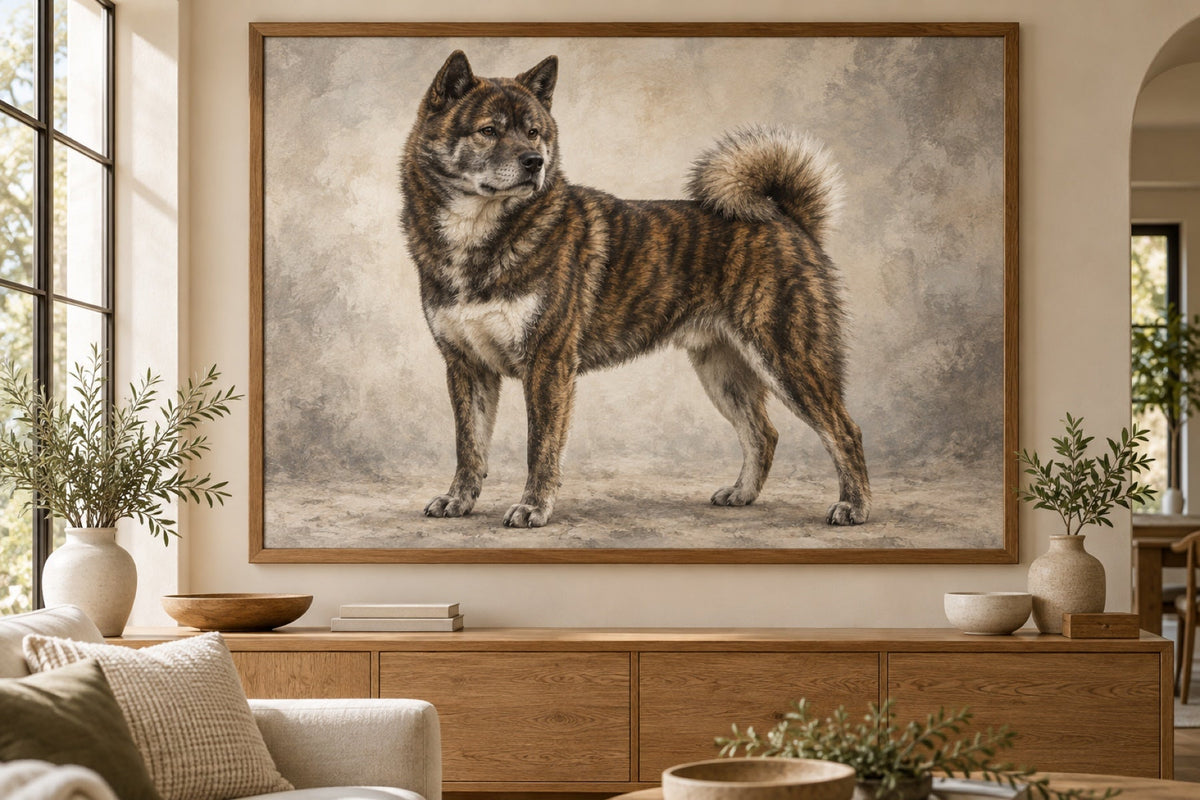
The Ainu, the indigenous people of Hokkaido island, bred these dogs to hunt bears and other game. Hence the alternative name Ainu-ken. Since Japan declared it a natural monument in 1937, the breed has carried its home island’s name.
| FCI | Group 5 (Spitz and primitive types), Section 5 Asian Spitz and related breeds, Standard No. 261, without working trial |
|---|---|
| Country of origin | Japan |
| Size (height at the withers) | Males 48,5 to 51,5 cm, females 45,5 to 48,5 cm |
| Weight | not specified in the FCI standard |
| Life expectancy | no reliable study figure found (N/A) |
| Coat | hard, straight outer coat with soft, dense undercoat; relatively long, stand-off hair on tail |
| Colours in the standard | sesame (mixture of black, red and white hairs), brindle, red, black, black-and-tan and white; piebald is a fault |
With settlers to the northern island
According to the standard, it probably descends from medium-sized Japanese dogs accompanying emigrants from Honshu to Hokkaido in the Kamakura period. The FCI definitively recognised it in 1964. Among Japanese breeds, it falls between the small Shiba and large Akita, while the Kai and Shikoku are similar in size.
Loyal, courageous and independently minded
The standard praises stamina, natural nobility, loyalty, responsiveness, courage and good judgement. You notice that judgement day to day: it weighs things up before following. Consistency, patience and a good bond achieve more than severity. It does not always get on with unfamiliar dogs; early socialisation pays.
Built for ice and snow
According to the standard, it tolerates freezing cold and heavy snow. Heat is more of a problem, so summer walks belong in the early morning. It sheds the undercoat in clumps twice a year, requiring daily brushing then; otherwise weekly brushing suffices. A blue-black tongue is not a fault.
What a bear hunter needs
Long hikes, tracking and outings together in varied terrain suit it. Hunting instinct is real, so use a long line where game is abundant. Small pets at home are a challenge.
An eye gene with a high carrier rate
A 2012 case study described a nine-month-old female with Collie Eye Anomaly, a congenital malformation at the back of the eye. She had the known NHEJ1 gene deletion. In a small test of 17 dogs from three kennels, 12 carried one copy and 5 two copies (Mizukami et al. 2012). The authors infer a very high frequency in the breed. If both parents carry the variant, puppies may inherit two copies; parental genetic testing provides clarity. No reliable lifespan figure exists, and McMillan et al.’s British analysis did not analyse the breed.
The right dog for you if
you have experience with independent dogs, enjoy being outdoors in all weather and want a loyal, serious companion that does not constantly seek entertainment but still needs challenges.
Choose another if
this is your first dog, you expect instant obedience or you live in a hot attic flat.

Find out whether an independent hunting spitz suits you in the breed quiz , or more thoroughly with our book “Welcher Hund passt WIRKLICH zu dir?” (book in German). For the first weeks with a puppy, there is the free Puppy Starter Pack. Sesame markings look particularly lovely as a portrait in a wooden frame, with more styles in our dog portraits.
Further reading
- The socialisation period: why “as much as possible” is the wrong advice
- Autumn shedding in dogs and cats: what is normal and what is not
- Puppy biting: teaching bite inhibition without spoiling the fun
Sources, accessed on 20.10.2026: FCI-Standard Nr. 261 Hokkaido (fci.be, German version dated 26.03.2018, valid standard published 30.10.2016); Mizukami K et al., Collie eye anomaly in Hokkaido dogs: case study, Veterinary Ophthalmology 2012; McMillan KM et al., Longevity of companion dog breeds: those at risk from early death, Scientific Reports 2024 (breed not analysed).
The links to our books are affiliate links. Buying through them supports us at no extra cost to you.


