

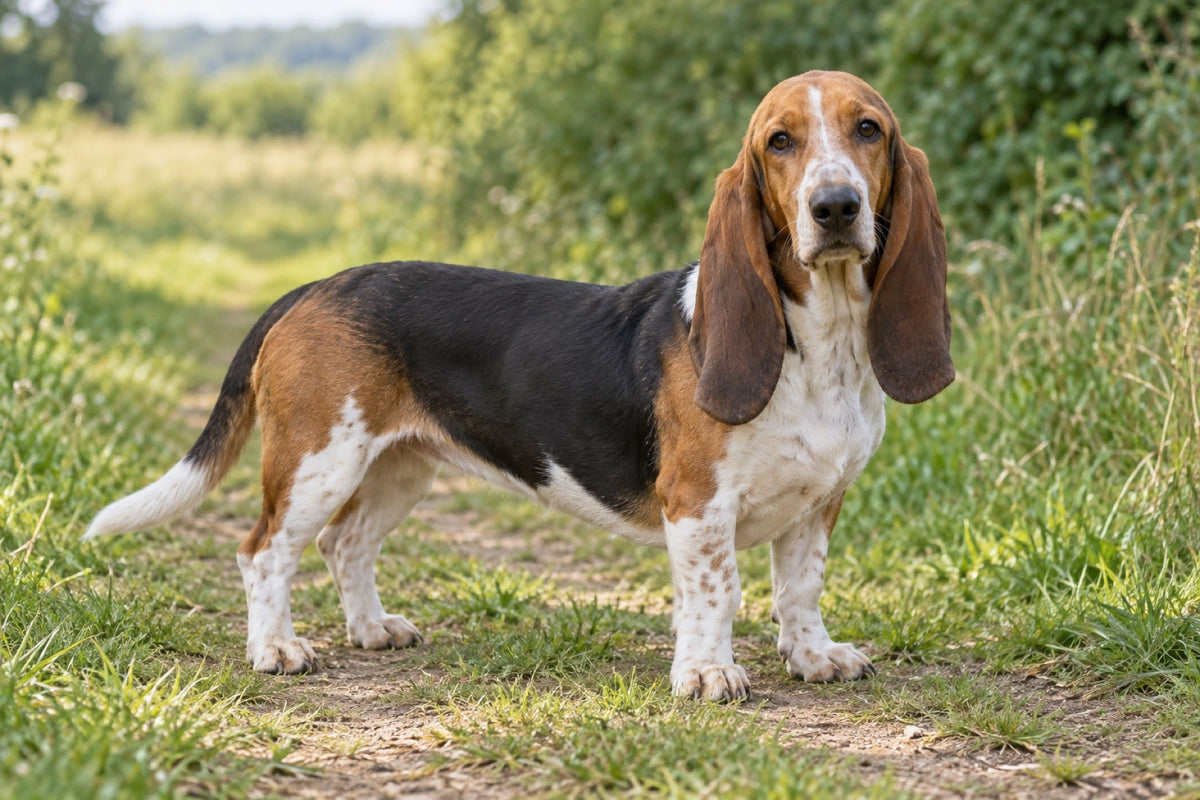
Two breeders, two ideas: in the 19th century, Le Couteulx de Canteleu developed a French Basset with straight forelegs, while Louis Lane produced one with turned-out legs. The Norman Artesien Basset (Basset Artésien Normand) standard follows the second approach; straight legs are now grounds for disqualification.
| FCI | Group 6 (Scent hounds and related breeds), Section 1.3 Small-sized hounds, Standard No. 34, with working trial |
|---|---|
| Country of origin | France |
| Size (height at the withers) | males and females 30 to 36 cm, with a 1 cm tolerance for exceptionally good dogs |
| Weight | 15 to 20 kg |
| Life expectancy | no reliable study figure found (N/A) |
| Coat | short, close-fitting and not too fine |
| Colours in the standard | fawn with a black blanket and white (tricolour), or fawn and white (bicolour); in tricolours, the head is predominantly tan |
From the Artois type to the Normand type
According to the standard, deliberate breeding of the short-haired French Basset began in the 1870s, with the name and club recognised in 1924. In 1930, the Société de Vénerie stated that the Artésien Normand was only a transitional stage towards a pure Normand type. Bred for shooting small game, preferably rabbits, these dogs have a British relative developed from similar stock: the Basset Hound.
Turned forelegs as a requirement
The 2023 FCI standard requires short, sturdy forelegs, “half or a little less than half twisted”, with the twist sufficiently visible. Its disqualifying faults explicitly include completely straight forelegs. A dog standing on straight legs is therefore excluded. Skin folds at the wrists count as a quality feature, lower-eyelid conjunctiva may sometimes be visible and body length to height is around 8 to 5.
The risks of a long, low body
No study specific to this rare breed was found. Across breeds, a UK study measured 700 dogs at a referral hospital, 79 with thoracolumbar disc extrusion. The longer the back relative to height at the withers, the higher the risk: in Miniature Dachshunds, the probability rose from 0.30 to 0.68 as the ratio increased from 1.1 to 1.5. Excess weight and a smaller skeleton added to the risk; the authors advise against further promoting long backs (Packer et al. 2013).
Slow, vocal and thorough
An exceptionally fine nose keeps this dog reliably on the trail, giving voice while hunting, slowly but systematically, alone or in a group. The standard describes a cheerful, very affectionate temperament.
Everyday life on short legs
Leisurely sniffing walks suit the breed better than jumping. Carry your dog on stairs and use a car ramp. At 15 to 20 kg, weighing food matters. The short coat is easy to maintain; check the very long ears, cheek folds and eyes several times weekly.
Who this dog suits, and who it does not
If you still choose this breed, it suits calm people who walk slowly and keep lasting watch over back, weight and ears. Staircases without lifts and homes without veterinary savings are unsuitable. Ask breeders about their aims for the forelegs, and favour dogs with legs as straight as possible.

Before bringing home a short-legged Basset, try the breed quiz. It also introduces scent hounds without an imposed body shape, such as the longer-legged Chien d’Artois or Beagle. Our book “Which Dog REALLY Suits You?” (book in German) helps weigh the decision. Ask shelters and rescue organisations before visiting a breeder. For the first weeks, there is the free Puppy Starter Pack; find more breeds in the Dog Breed Encyclopedia.
Further reading
- Dachshund: the back that shapes a whole life
- Is my dog overweight? Assessing body condition and ideal weight
- Beagle: a nose with a dog attached, and what that means day to day
Sources, accessed on 20.10.2026: FCI Standard No. 34 Basset Artésien Normand (fci.be, German and English versions dated 29.08.2023, valid original standard dated 01.08.2023); Packer RMA et al., How Long and Low Can You Go? Effect of Conformation on the Risk of Thoracolumbar Intervertebral Disc Extrusion in Domestic Dogs, PLOS ONE 2013; McMillan KM et al., Longevity of companion dog breeds: those at risk from early death, Scientific Reports 2024 (breed listed but not analysed).
Links to our books are affiliate links. Buying through them supports us at no extra cost to you.


