
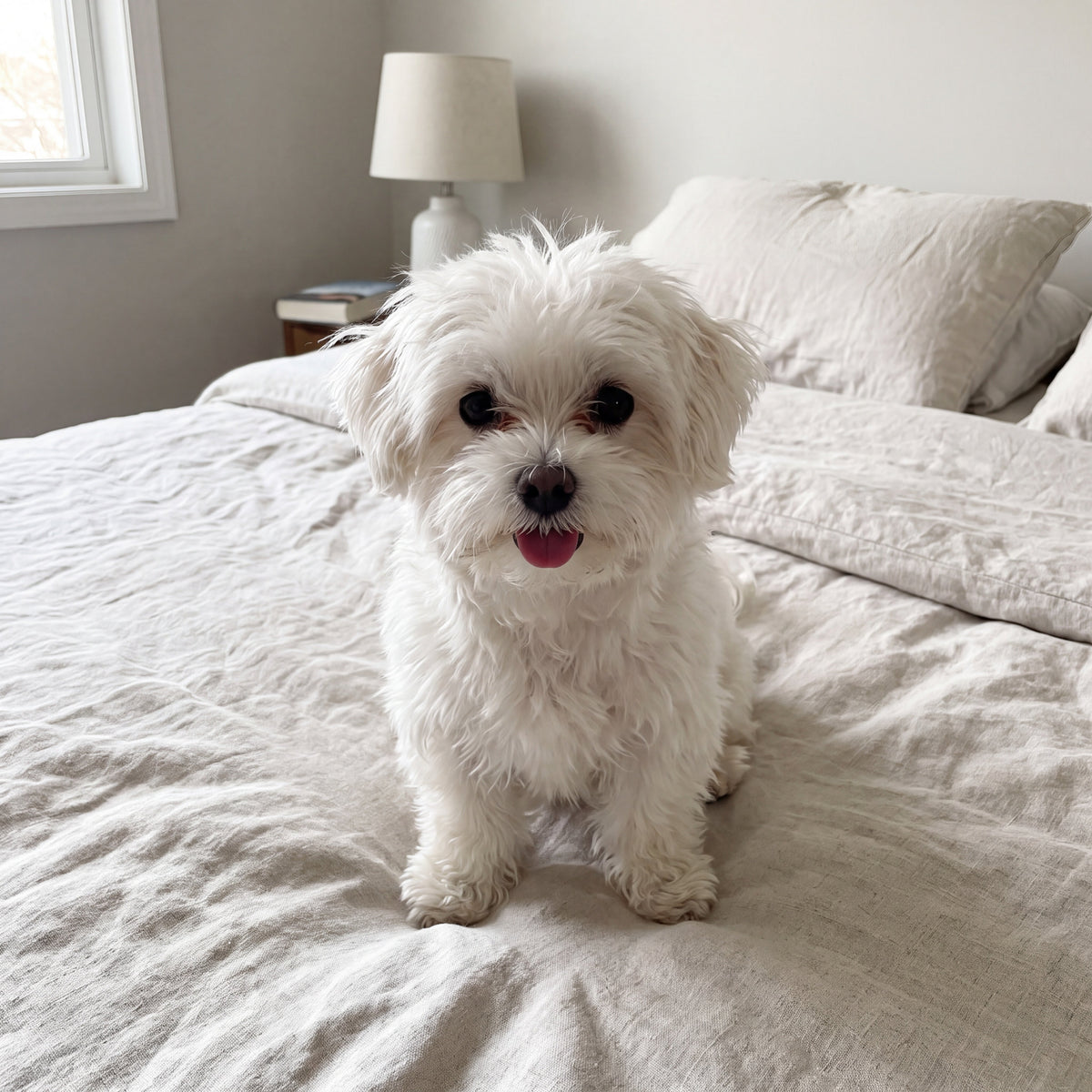
The Maltese looks as if he had been designed specially for photos: gleaming white, silky hair, dark button eyes. This very look is also his biggest misunderstanding. Anyone who gets him for his looks does not distinguish between a well-groomed Maltese in a photo and the daily effort behind it. In character he is a sociable, eager-to-learn little dog. In looks he is a full-time job.
Maltese: the hard facts
- Origin: Mediterranean region, one of the oldest European companion dog breeds, not from Malta despite the name
- Size: Males 21 to 25 cm, females 20 to 23 cm, 3 to 4 kg
- Coat: Very long, silky, smooth, pure white, no undercoat
- Life expectancy: 12 to 15 years
- Temperament: Affectionate, lively, attentive, willing to learn, people-oriented
Temperament: small, attentive, surprisingly clever
The Maltese was bred for centuries purely as a companion dog, and you can tell. He is focused on people, reads moods well and learns quickly when you work with him kindly. Tricks, small tasks and dog sports such as rally obedience work better with him than many expect.
He is watchful and lets you know what is going on in the stairwell. Whether that turns into constant barking is decided by training in the first months, not by the breed. With strangers he is usually open, with children patient, as long as they understand that a three-kilo dog is not a toy.
His main theme is bonding: he wants to be there, always. Staying alone is hard for him and has to be built up patiently from the start, otherwise separation stress develops. How that works is in our guide Leaving a dog alone.
Five points that count before buying
1. The coat is daily work, not weekly
Maltese hair grows continuously, much like human hair, and has no undercoat. He therefore hardly sheds, but mats quickly. If you want the full length, you have to brush daily, partly wrap the hair and bathe regularly. Most owners opt for a short cut, and that is the sensible choice. Even then, expect a groomer appointment every six to eight weeks and ongoing costs that quickly reach four figures over a dog's life.
2. Tear stains are almost unavoidable
Rust-brown discolouration under the eyes occurs when tear fluid meets white hair. On a white dog you see it immediately. Causes can be tear ducts that are too narrow, dental problems, allergies or simply anatomy. Careful daily cleaning keeps it in check. If you expect your Maltese to look permanently as flawless as in breeder photos, you will be disappointed.
3. Teeth and kneecaps
As with all very small breeds, the teeth are crowded, which encourages tartar and early tooth loss. Baby teeth often do not fall out by themselves. Tooth brushing is part of basic care in this breed. Then there is luxating patella, the displacement of the kneecap, which can range from a slight hop to surgery. Other issues are liver shunt and an increased risk of low blood sugar in puppies.
4. Hands off teacup and mini offers
Labels such as teacup Maltese or mini Maltese are not recognised variants, they are sales arguments. Dogs well below the breed standard are more often ill than average: brittle bones, heart problems, low blood sugar, shortened life expectancy. A puppy from a checked breeder via the VDH costs 1,400 to 2,000 euros. Anyone advertising extreme smallness is selling a health risk.
5. Small does not mean undemanding
A Maltese needs daily walks, brainwork and contact with other dogs. He is not a flat accessory who gets by with a balcony. And he needs the same rules as a large dog: if you pick him up as soon as things get uncomfortable, you take away his chance to learn that he can cope himself.
Care: what he really needs
- Daily coat care or a short cut. Either is fine, doing nothing is not.
- Eye care as a routine. Gently clean every day to keep tear stains in check.
- Dental care from the start. Establish tooth brushing as a normal habit in puppyhood.
- A harness instead of a collar. With very small dogs this protects the delicate neck.
- Real contact with other dogs. He has to learn to move among dogs instead of being carried.
Who is the Maltese right for?
For people in flats and cities who are at home a lot and want an attentive, affectionate small dog. For older owners who want a manageable companion, and for families with children old enough to handle a small dog gently. And for everyone who either enjoys doing coat care themselves or budgets for it.
Not for full-time workers without care arrangements, not for people who want an easy-care dog, and not for households with very small children. If you want something similarly small but much easier to care for, take a look at the short-coated Chihuahua.
Frequently asked questions
Is the Maltese a dog for allergy sufferers? He hardly sheds, because his hair grows continuously instead of falling out in a cycle. That reduces the amount of hair in the home, but does not remove allergens from saliva and dander. There are no allergy-free dogs. Spend time with an adult Maltese before you decide.
How often does he need to go to the groomer? With a short cut every six to eight weeks, with long hair correspondingly less often, but with daily effort at home. An appointment costs 50 to 90 euros depending on the region.
Does he bark a lot? He is watchful and likes to sound the alert. Whether that turns into constant barking depends almost entirely on whether the alerting is rewarded or calmly ended in the first months.
White coat in front of the camera
Pure white fur is the supreme discipline: against a light background the dog disappears, in direct sun the details burn out. So photograph him against a medium-dark, calm background in soft daylight at the window, not outside in the midday sun. In watercolour the silky hair looks especially lively, because the style works with soft gradients. More on this in our photo tips.

The best moment for the photo is the day after the groomer appointment. As an instant download, the watercolour is with you the same evening, and you print later in whatever format you want then. The same design ready printed is at the dog portraits.
Keep reading
- Havanese: beginner-friendly does not mean undemanding: similarly affectionate, somewhat sturdier
- Yorkshire Terrier: three kilos of terrier, not an accessory: the same long hair, a completely different temperament
- Learning to leave a dog alone: for a companion dog, the most important exercise


