
There is a table on the back of the food bag. Dog, 20 kilos: 278 grams a day. That sounds precise, and most families stick to it, every day, for years. Except the table does not know that your dog is neutered, prefers lying on the sofa to running and still gets a chew bone in the evening.
With a perfectly ordinary dog of 20 kilos, neutered, two walks a day, around 50 grams of food too much can add up that quickly. Every day. Over a year that is a good 18 kilos of food, almost as much as the dog himself weighs. Nobody did anything wrong. Nobody ever simply checked the number on the bag.
Checking it is no rocket science. You need your dog's weight, an honest look at his daily life and the energy value of your food. A pocket calculator does the rest, or our free food calculator.
Why the table on the bag is only a starting value
Manufacturers have to give a feeding recommendation, and for that they calculate with an average dog. But there is no such thing. Two dogs of the same weight can use very different amounts of energy. After neutering, the requirement drops noticeably in many dogs. A young, playful dog needs more than an older one who would rather sniff than run. And treats, chews or the leftovers from lunch appear in no table.
Then there is the food itself. Two dry foods can differ considerably in their energy. If you switch brands and keep the number of grams, you suddenly feed more or less without noticing. That is why we do not calculate in grams, but in energy, that is, in kilocalories. The grams only come at the very end.
Daily amount in five steps
Step 1: The right weight
You calculate with the weight your dog would have at an ideal body shape. Whether he is there is shown by your hands: the ribs should not be visible, but should be easy to feel with light pressure. From above a waist is recognisable, and from the side the belly rises towards the back. Vets use a scale from 1 to 9 for this. Steps 4 and 5 are the ideal range. If your dog is there, you simply take his current weight.
If he is clearly rounder or thinner, you calculate with the estimated ideal weight. A dog of 20 kilos at step 7 weighs about a quarter too much, so his ideal weight is around 16 kilos. With clear overweight or underweight, an appointment at the vet's practice comes first.
Step 2: The metabolic weight
A dog of 40 kilos does not need twice as much food as one of 20 kilos, but clearly less than double. Large bodies use less energy in proportion. The nutrition guidelines therefore calculate with the metabolic weight: body weight to the power of 0.75. On a phone calculator this works with the power key, usually "x^y".
For our dog of 20 kilos: 20 to the power of 0.75 gives 9.46.
Step 3: The factor
Now everyday life comes into play. You multiply the metabolic weight by a number that fits your dog:
| How your dog lives | Factor |
|---|---|
| gains weight quickly | 90 |
| low activity or neutered: under an hour of exercise a day, mostly on the lead | 95 |
| moderately active: one to three hours a day, rather calm | 110 |
| very active: one to three hours a day with running, romping, dog sports | 125 |
| working dog: three to six hours a day | 150 to 175 |
An honest assessment helps. Two hours outdoors are not two hours of exercise if an hour and a half of that is sniffing and standing around. If you are torn between two levels, take the lower one. You can always adjust later, and giving more food is easier than giving less.
Step 4: The daily requirement in kilocalories
Metabolic weight times factor gives the daily requirement. For the moderately active 20-kilo dog that is 9.46 times 110, so around 1,040 kilocalories a day. If the same dog is neutered and rather laid-back, you calculate with factor 95 and arrive at around 898 kilocalories. A difference of almost 150 kilocalories, every day.
Step 5: From kilocalories to grams
Many bags state how much energy is in 100 grams of food, often as "metabolisable energy" or "ME". Then you calculate: daily requirement divided by kilocalories per 100 grams, times 100.
A dry food with 374 kilocalories per 100 grams gives 278 grams a day for the moderately active dog. Exactly the number from the bag. For the neutered, laid-back dog, on the other hand, it is only 240 grams. That is where the almost 40 grams that end up in the bowl every day too much come from, and the treats are not even counted yet.

Treats belong in the calculation
Vets recommend that treats make up at most a tenth of the daily energy. For the 20-kilo dog with 1,040 kilocalories that is 104 kilocalories for rewards and chews. That leaves 936 kilocalories for meals, so 250 grams of our example food instead of 278. Anyone who gives treats and leaves the full amount in the bowl feeds too much every day, even if every single reward looks small.
This adds up especially quickly in families. Everyone gives a little, nobody knows about the others. A shared note on the fridge saying what the dog has already had today helps more than any good intention.
And if there are no calories on the bag?
Then the energy can be estimated from the analytical constituents: crude protein, crude fat, crude fibre, crude ash and moisture. The calculation for that is a bit longer, because it takes into account how much the dog actually digests. Our food calculator takes care of it for you, you just type in the values from the bag.
The check on the dog
Every calculation gives a starting value, not a guarantee. Breed, coat, weather and temperament shift the requirement, and even healthy middle-aged dogs differ by more than a third. That is why every new amount needs a check after two weeks: feel the ribs, look at the waist, ideally weigh him too. If your dog is gaining weight when he should not, give about a tenth less. If he is getting too lean, a tenth more. After two to three weeks you check again. After a few rounds you have the amount that suits your dog, and not an average dog from the table.
Where the simple calculation ends
A different calculation applies to puppies, because they are growing and, in large breeds, growing too fast can harm the bones. Pregnant and nursing bitches, dogs with overweight that is to be reduced, and sick dogs also need more than the five steps. Here the vet's practice belongs at the table, and it sets the target values.
It is faster with the food calculator
If you do not want to key in the steps yourself: our free food calculator works out the daily requirement, treat budget and number of grams for your food in one minute. If you like, you get the result by e-mail in a clear layout, to print out or for the fridge.
Everything to calculate along with: the book
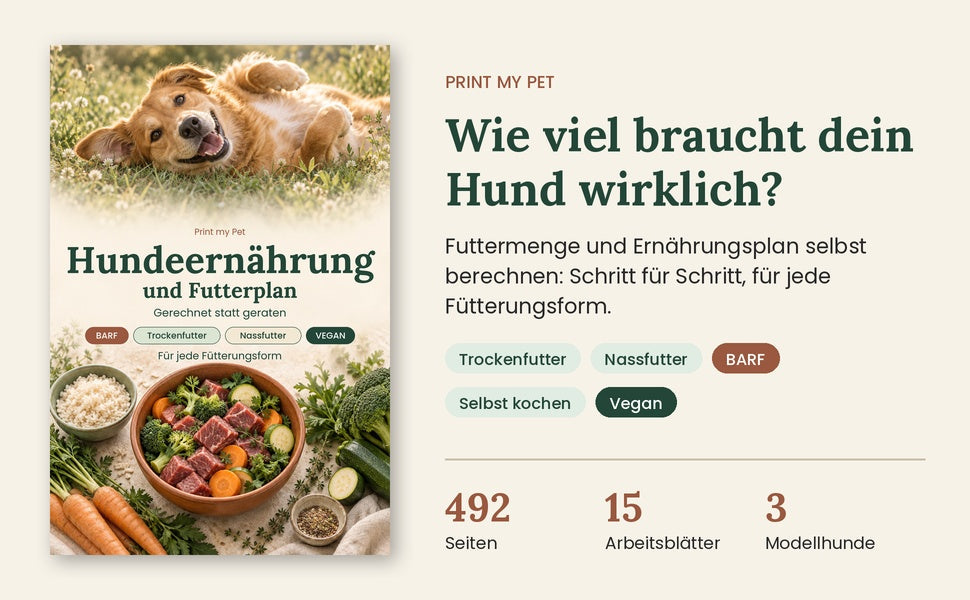
The five steps come from our book "Hundeernährung und Futterplan" (Dog Nutrition and Feeding Plan). In it we work through every feeding method for a small, medium and large model dog: dry food, wet food, BARF, home-cooked and vegan. There are also separate chapters for puppies, older dogs, overweight, allergy and other special cases, 15 worksheets to fill in and feeding plans for healthy adult dogs. More on our books page or directly on Amazon.
And once your dog has a waist again after the right amount, that might be the right moment for a portrait: dog portraits in all styles or the gifts for dog people.
To go with it: the food bowl with your dog's name, made of stainless steel with a motif band.
Further reading
- Old dog, new rules: how to give your senior the best years
- The first 30 days with a puppy: plan for weeks 1 to 4
- Puppy checklist: basic equipment and the first 3 days
The links to our books are affiliate links. If you buy through them, you support us at no extra cost to you.
Sources: FEDIAF Nutritional Guidelines for Complete and Complementary Pet Food for Cats and Dogs, Publication September 2025 (energy requirement, body condition scoring); National Research Council (2006): Nutrient Requirements of Dogs and Cats (energy from the analytical constituents). Retrieved on 26.09.2026. The example calculations come from the book "Hundeernährung und Futterplan" by Print my Pet.


