
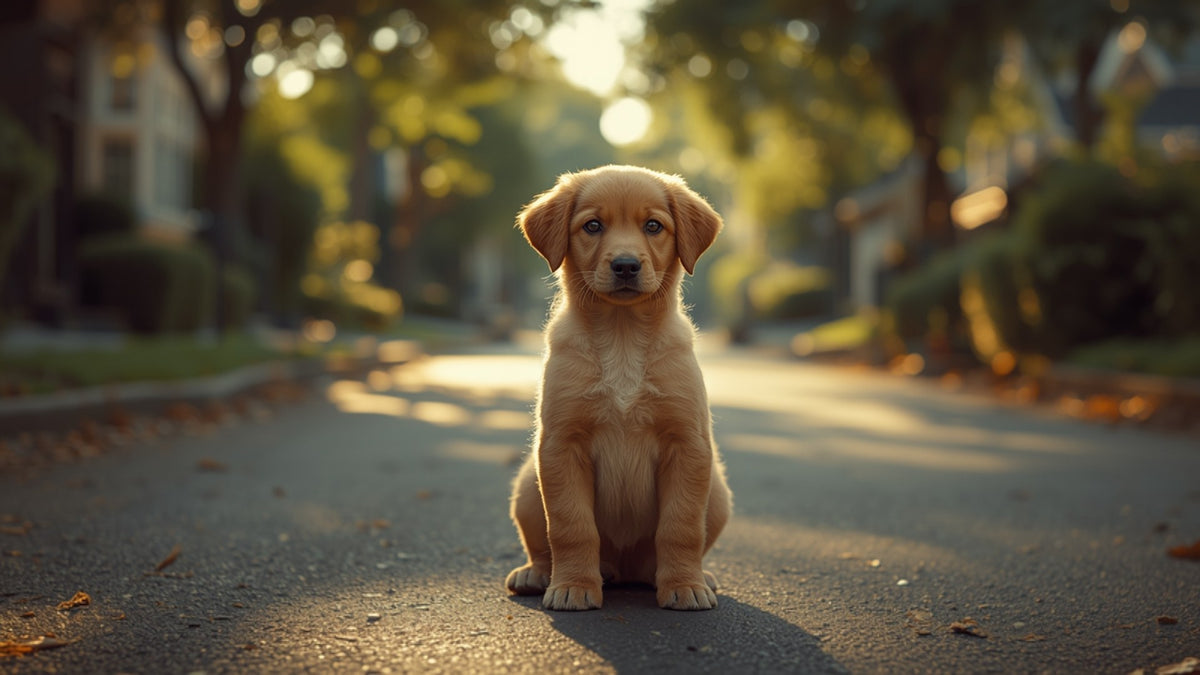
The imprinting period is the window between the third and the fourteenth week of life in which a puppy decides what is normal in his world and what is dangerous. What he experiences calmly during this time usually stays a non-event for the rest of his life. What is missing, or overwhelms him, often turns into fear or avoidance later. The most common advice, to show him as much as possible, is exactly the wrong one: what counts is not the number of impressions, but the state the puppy is in when he leaves them.
What the imprinting period is and when it ends
The imprinting period, also called the sensitive period or socialisation period in behavioural research, starts at about three weeks of age and closes gradually between the twelfth and sixteenth week. In this window a puppy's brain learns particularly fast and particularly lastingly which stimuli belong to normal life and which deserve a reaction. A puppy who calmly meets a wheelchair, a child on a balance bike or a pneumatic drill during this time will usually consider it everyday life as an adult dog. If contact is missing completely, the same situation can trigger panic years later, even when objectively nothing is happening.
The window does not close like a door slamming shut. After the fourteenth week it just becomes increasingly harder to store new things as normal, but not impossible. Anyone who takes in an older puppy or a dog from animal welfare works with the same principle, only more slowly, with more repetition and more patience for setbacks.
A large part of this window, the third to eighth week, still takes place at the breeder's or the rearing facility, long before the puppy even moves in with you. If he grew up there in a calm home kitchen with everyday noises, he already has a head start. If he grew up isolated in a kennel without visitors, you catch up on that gap in the first weeks at home, but not back to zero. That is exactly why, when buying a puppy, it is worth looking at the rearing rooms, not just at the papers.
The mistake of "as much as possible"
Many guides sound like a competition: the more people, places and sounds during the imprinting period, the better the later dog. In practice the opposite is often true. A puppy who experiences the train station, a children's birthday party and the vet's practice on a single afternoon does not collect three positive experiences. Most of the time he collects a single one, called overwhelm, and it echoes on into the following days.
What matters is not how many situations pile up in one day, but the state the puppy is in when he leaves them. Calm, curious, with a loosely hanging tail is a success, even if it was only one short encounter. Frozen, panting or with the tail tucked is a step back, no matter how harmless the situation looked from the outside. A puppy who watched the playground calmly for ten minutes has learned more than one who was passed around between children's hands for an hour.
The same goes for puppy play sessions. Five puppies let loose on each other uncontrolled for twenty minutes do not imprint friendliness, but often learn that strange dogs are stressful. A good puppy group separates by size and temperament, lets only two or three play at a time and actively takes puppies out of the melee as soon as one seems overwhelmed. Less, but more suitable, beats the big group here too.
The distance rule
The simplest way to avoid overwhelm from the start is a single question before every new situation: how far away do I have to stay so that my puppy remains relaxed? This distance, not the shortest possible one, is the right starting point. With a loud pneumatic drill that can mean fifty metres, with a strange, calm dog on a lead ten is often enough.
From this safe distance you only move closer if the puppy shows interest of his own accord: ears pointing forward, body loose, maybe a few steps of his own towards the source of the stimulus. If he pulls back instead, freezes or loses interest in food, the current distance is already too small. Then you move further away, not closer, even if that feels unusually slow. This rule works equally for people, dogs, sounds and places, and it is more patient than it feels in the moment.
Ten situations that count
Not every experience is equally valuable. These ten come up most often in everyday life later and are especially worthwhile during the imprinting period, in small, calm doses:
- People of different ages and appearance: children, people with beards, hats, wheelchairs or walking sticks
- Other dogs known to be friendly and vaccinated, in a controlled setting
- Traffic from a safe distance: parked and moving cars, bicycles, a bus at the stop
- Household noises: vacuum cleaner, blender, doorbell, clattering dishes
- Different surfaces: metal grating, gravel, tiles, a staircase with open steps
- A short visit to the vet's practice without treatment, just for weighing and a cuddle
- Short car journeys that do not end at the vet every time
- Being alone for seconds, in the next room, with the door ajar
- Touch on paws, ears and muzzle, as needed later for claw trimming
- Rain, wind and dusk, not just sunny afternoons
All these points appear as a socialisation bingo with fifty experiences in the free starter pack further down, to tick off instead of inventing them in your head.
The weeks of the imprinting period are often the ones the loveliest photos come from later: the alert gaze, the ears that are still too big, the uncertainty that turns into curiosity in the next moment. One of them as a canvas on the wall captures exactly this moment, not just somewhere in the phone gallery. All styles and formats are in the dog portraits.
How to tell it was too much
An overwhelmed puppy rarely screams. He goes quiet, and people often mistake exactly that for calm, when it is the opposite.
| Signal | What it usually means |
|---|---|
| Tucked tail, ears laid back | Insecurity or fear |
| Yawning without being tired, licking over his own nose | Appeasement, rising stress |
| Panting without exertion or heat | Excitement or fear |
| Freezing, suddenly no interest in food | Overwhelm, stimulus too close or too long |
| Unusual tiredness or irritability the next day | Aftereffect of too many impressions at once |
If your puppy shows two or more of these signals, only one thing helps: increase the distance immediately, end the situation calmly and do less the next day than the day before, not more. This article does not replace veterinary advice: if a puppy seems fearful, apathetic or not like himself at all for days, that belongs in the vet's practice or with a qualified dog trainer, not in the next socialisation plan.
What is still possible afterwards
Nothing is lost by the sixteenth week if it has not worked out until then. A young dog keeps learning, just no longer at the same pace as at eight weeks, and needs more repetition instead of one-off experiences. For the first walks on the lead, which often fall in the same period, the same principle applies as above: short, calm sessions beat long, exciting rounds, more on that elsewhere.
An adult dog who got to know little as a puppy is not a hopeless case either. Progress comes more slowly and, with professional support, often more reliably, but behaviour stays teachable, well beyond the first year of life. The imprinting period makes the start easier. It is not the only chance a dog gets in life.
Where exactly the imprinting period falls in the course of the first weeks and what else is coming up in the remaining weeks is shown in the full plan in the first 30 days with a puppy.
If you want to go deeper than the imprinting period, with recall, impulse control and the first cues, you will find the sequel in Welpenerziehung & Junghundtraining (Puppy Training & Young Dog Training).
The complete starter pack, free
Everything important from the first thirty days on 50 printable pages: the honest shopping list, the first 72 hours hour by hour, a 4-week plan, a socialisation bingo with 50 experiences and the emergency page for the fridge.
The first 30 days, download here for free
Further reading
- Puppy checklist: basic equipment and the first 3 days: what should already be in the house before the imprinting period
- Puppy won't sleep: what really helps on the first night: the first, most intense night of a puppy's life
- Puppy training: the 5 rules that really work: the training principles for the time after the imprinting phase
Source: American Veterinary Society of Animal Behavior (AVSAB), Position Statement on Puppy Socialization. Retrieved on 23.09.2026.
The links to our books are affiliate links. If you buy through them, you support us at no extra cost to you.


