
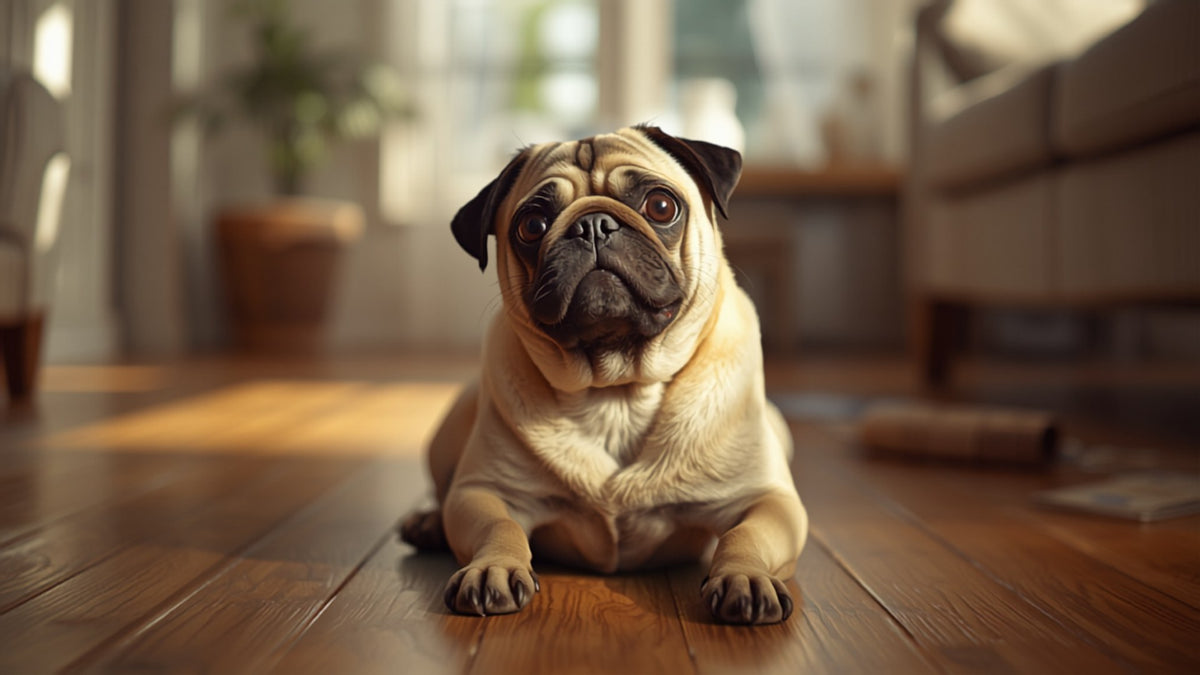
Multum in parvo, much in little, is the old motto of the breed. A pug is never just a dog in the room. He is mood, commentary, comedy. He snores, he grunts, he looks at you as if he had an opinion, and most of the time he has one. Hardly any breed is loved so unconditionally. And hardly any breed has suffered so much from that love. That is why this article is more honest than some pug fans would like. Not against the pug. For him.
Breed profile
- Origin: China, in Europe since the 16th century, court dog of Dutch and English nobles
- Height: 25 to 30 cm
- Weight: 6 to 8 kg, often clearly more, and that is the problem
- Life expectancy: 12 to 15 years with healthy breeding
- Coat: short, dense, fawn with a black mask or all black
- Temperament: people-oriented, playful, good-natured, stubborn, with humour
Temperament: a dog who is company
For centuries the pug was bred exclusively as a companion, not as a hunter, not as a guard. You can tell: he wants to be with you, always. He follows you into the bathroom, lies on your feet, watches you cook. He is friendly to strangers, children, cats and other dogs, he knows no enemies. And he has that humour that comes from a mixture of wrinkly face, big eyes and a wilful head.
He is stubborn too. A pug who does not want to, sits down. A pug who does not want to go out because it is raining looks at you until you give in. Training works, but through food and charm, never through pressure.
What the short nose costs
1. Breathing is issue number one
The pug is a brachycephalic dog, a short-headed dog. The nose was bred away, the soft tissue in the throat stayed. The result is called BOAS, Brachycephalic Obstructive Airway Syndrome: wheezing when breathing, panting at 22 degrees, collapse in heat, poor sleep. Not every pug has a hard time, but very many do. What you can do: only buy a pug with a recognisable nose and open nostrils, from a breeder who pays attention to breathing (the Retro Pug and the Old German Pug are attempts to breed healthy lines back). In summer go out early and late, never in the midday heat, never in the car. And with heavy wheezing see the vet: soft palate surgery can improve life considerably.
2. The eyes
The big, protruding eyes are charming and at risk. Corneal injuries from blades of grass, scratches, draughts. Dry eyes, because the lids do not close. A pug needs a daily eye check and, with blinking or tears, the vet straight away. A lost eye is not uncommon in this breed.
3. The wrinkles
The nose fold is a moist chamber. If it is not cleaned and dried regularly, it becomes inflamed, smells and itches. Two to three times a week with a soft cloth, daily for some.
4. Weight
A pug cannot run much, so he moves little, so he gets fat, so he can breathe even less. This cycle kills more pugs than any other cause. A pug has to have a waist. Weigh the food, no table scraps, and exercise in short, frequent sessions.
5. The breeding question
In Germany the pug is on the list of breeds that can fall under the ban on extreme breeding, and in the Netherlands the breeding of extreme forms is already banned. That is not an attack on the breed, but an attempt to save it. Only buy from breeders who do breathing tests, do not breed extreme heads and show you the parents walking. The pug who walks 500 metres and then gasps is not cute. He is suffering.
What a pug needs in daily life
- Coolness. From 25 degrees it becomes dangerous. Cooling mat, shade, water, no midday walks.
- Short, frequent exercise. Three times 20 minutes instead of one hour.
- Harness instead of collar. Always. The larynx is sensitive.
- Care routine. Wrinkles, eyes, ears, weight, every week.
- Surgery insurance. Soft palate, eyes, discs: the pug is an expensive patient.
Who is the pug right for?
For people who are at home a lot and want a dog who is always with them. For families with children, because hardly any dog is more patient. For city flats without much room to roam. Not for athletes, not for people who want to hike in summer, and not for anyone who is not willing to search and pay for a healthy puppy.
The pug is the breed where the heart speaks loudest and the mind quietest. If you are facing exactly this decision: in „Welcher Hund passt WIRKLICH zu dir?“ (Which Dog Is REALLY Right for You?) the chapter on short-headed breeds is deliberately at the start, not in the appendix.
Frequently asked questions
What does a healthy pug cost? 1,500 to 2,500 euros from a breeder with a breathing test and eye results. Less is suspicious.
What is a retro pug? A back-breeding with Parson Russell or Pinscher content, with a longer nose and better breathing. For many families the better choice.
Does every pug snore? Almost every one. In some it is cute, in some it is a symptom. The vet can tell the difference.
The wrinkly face as a subject
The wrinkly face, the big eyes, the tilted head: the pug was born for the cartoon style and for the majestic oil painting as a king or general, the contrast is unbeatable. Photograph him at eye level with window light, so that the wrinkles get definition and the eyes glow.

A wrinkly face needs size, otherwise the detail is lost. From 40 by 60 centimetres every wrinkle comes through, and the serious look suddenly seems like a family portrait from a castle. Posters, canvas, wooden frames and acrylic glass are with the dog portraits.
Read more
- What the breathing trouble of the French Bulldog costs in daily life: same short nose, same questions
- Chihuahua: why the yapping is home-made: the other little city dog
- Old dog, new rules: because short noses need consideration earlier
The links to our books are affiliate links. If you buy through them, you support us at no extra cost to you.


