
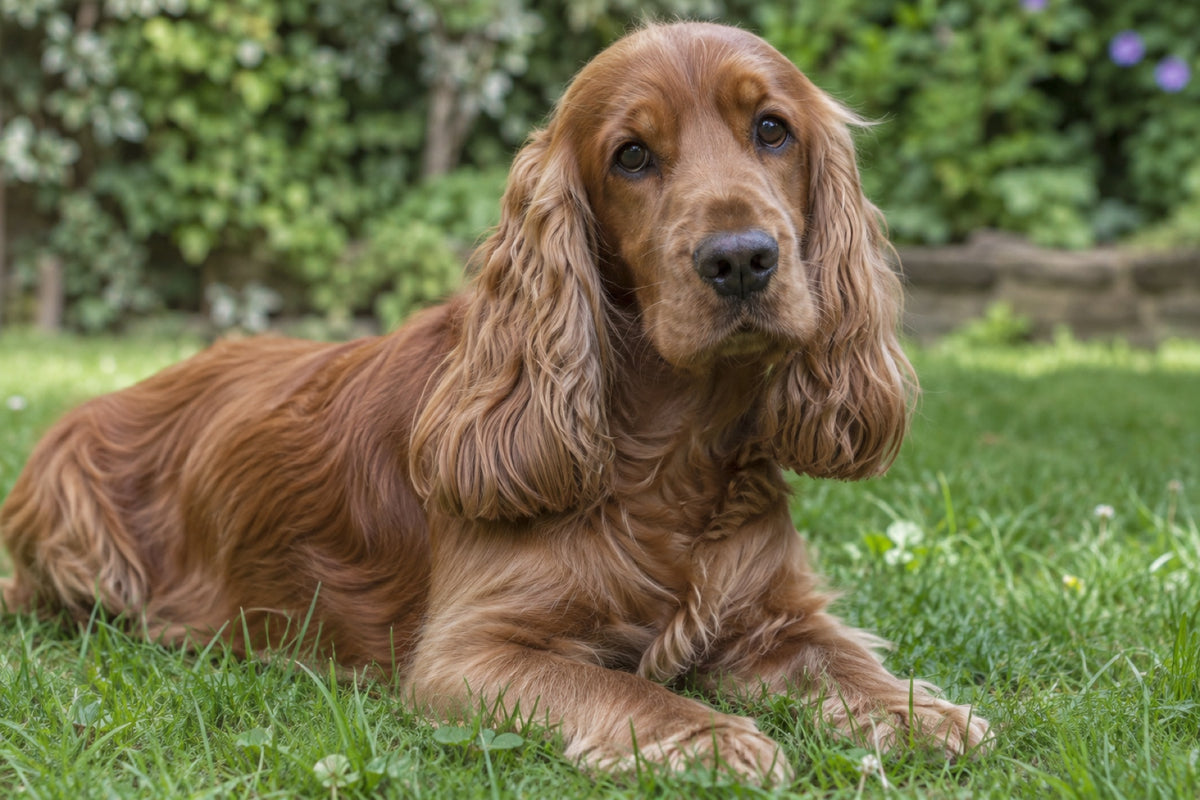
The Cocker Spaniel is seen as the cheerful family dog with the floppy ears, and that is true. What tends to get lost is that he is a hunting dog. He was bred to spend hours flushing game out of the undergrowth, and that disposition does not disappear just because he now lives in a terraced house. An under-stimulated Cocker finds his own work, usually with his nose to the ground and his owner at the other end of the lead.
Breed profile: English Cocker Spaniel
- Origin: England, bred as a flushing dog for hunting woodcock, hence the name
- Size: Males 39 to 41 cm, females 38 to 39 cm, 12 to 15 kg
- Coat: Medium length, silky, smooth, with clear feathering on ears, legs and belly; many colour varieties
- Life expectancy: 12 to 14 years
- Temperament: Cheerful, people-oriented, sensitive, keen to work, nose-oriented
Temperament: good mood with a nose
The Cocker Spaniel is an exceptionally friendly dog. He greets people with his whole body, wags almost non-stop and fits well into family life. He is usually patient with children, uncomplicated with other dogs, and learns quickly when you work with him kindly.
At the same time he is sensitive. A loud tone hits him harder than most other dogs, and rules that apply today and not tomorrow visibly unsettle him. An unsettled Cocker withdraws or throws himself on his back in an exaggeratedly submissive way. Being clear while staying friendly is no contradiction with him, it is the condition.
What defines him is his nose. A Cocker in the woods is first and foremost busy scenting, not with you. That is not disobedience, it is his core skill. If you use this disposition instead of working against it, you get a balanced dog. Half an hour of dummy training in tall grass does more for him than an hour of distance on a farm track.
Where Cocker ownership fails
1. The ears are a permanent construction site
The long, densely haired drop ears close off the ear canal almost completely. It is warm and damp underneath, and bacteria and yeast love exactly that. Chronic ear infections are among the most common reasons for vet visits in this breed. Ears need to be checked regularly, dried after bathing and looked into at the first signs of head shaking or smell. If you let that slide, you will end up with an operation at some point.
2. Prey drive is underestimated
Especially dogs from working lines flush independently and are hard to recall in the woods. Anti-hunting training and a solid recall belong on the plan from puppyhood. If you only react once the dog has chased a deer for the first time, it is much harder.
3. The hereditary diseases you have to ask about
The biggest issue is the eyes. Progressive retinal atrophy leads to blindness over the years, and because there is a gene test for it, a reputable breeder has the parents' results to hand. Cataract also occurs. In the joints, hip dysplasia and kneecap displacement are the known points, and both can be checked before breeding. Rarer but serious: familial nephropathy, a hereditary kidney disease that hits even young dogs. In individual lines, autoimmune diseases also occur. A puppy from a checked breeder via the VDH costs 1,200 to 1,800 euros, and that price is essentially the cost of testing the parent animals.
4. The coat takes time or money
The feathering on ears, legs and belly mats quickly, especially after wet walks. Brushing two to three times a week is the minimum, plus an appointment with the groomer every eight to twelve weeks or trimming yourself. Burrs and grass seeds in the summer coat are a recurring theme.
5. He does not like being alone
The Cocker is strongly people-oriented and is one of the breeds in which separation stress is common. Staying alone has to be built up early and patiently. A Cocker who lies alone for eight hours on weekdays will eventually start barking or working on the door frame. Training against the symptom achieves nothing as long as the cause remains.
Care: what he really needs
- Nose work. Search games, dummy training, tracking. Half an hour of nose work replaces an hour of running.
- A solid recall. From a young age, consistent, with high-value rewards.
- Ear checks as a routine. Look weekly, dry after every bath.
- Regular coat care. Brushing several times a week, trimming or cutting every two to three months.
- Friendly, clear training. He is sensitive. Pressure makes him insecure, not cooperative.
Who is the Cocker Spaniel right for?
For active families and individuals who have time for exercise and activities every day and enjoy nose work. For people who are at home a lot. And for everyone who does not see coat care as a nuisance but as part of living together.
Not for full-time workers without care arrangements, not for people looking for an easy-care short-haired dog, and not for anyone who wants to be out in the woods off the lead without years of training beforehand. If you want something similarly friendly but less nose-driven, take a look at the Golden Retriever.
Frequently asked questions
What is the difference from the American Cocker Spaniel? The American Cocker is smaller, has a shorter muzzle, a rounder head and considerably more coat. He is rarer in Germany and needs more grooming. The English Cocker described here is the more original hunting dog type.
Does cocker rage syndrome really exist? In individual lines, above all solid golden Cockers, sudden outbursts of aggression have been described. It is rare and no longer a relevant issue in reputable breeding, but it should be a reason to get to know the parent animals and their temperament.
How much exercise does he need? Two to three hours outside a day are realistic, but not all of it as distance. A large part should be searching, sniffing and working.
Ears, light and the questioning look
The long, wavy ears and the soft, always slightly questioning gaze are the breed's trademark. In watercolour the feathering looks especially lively, while solid golden Cockers positively glow as an oil painting. Photograph him at eye level and make sure the ears do not disappear into shadow: side daylight at the window is usually quite enough. More on this in our photo tips.

A Cocker with ears in side light is a subject worth a poster. You get a preview beforehand and can still have details changed before it is printed. Which materials are available is at the dog portraits.
Keep reading
- What the cancer figures for the Golden Retriever mean: similarly friendly, much less nose-driven
- Learning to leave a dog alone: the point at which most Cocker households tip
- Autumn coat change: with feathering on ears, legs and belly, no minor matter


