
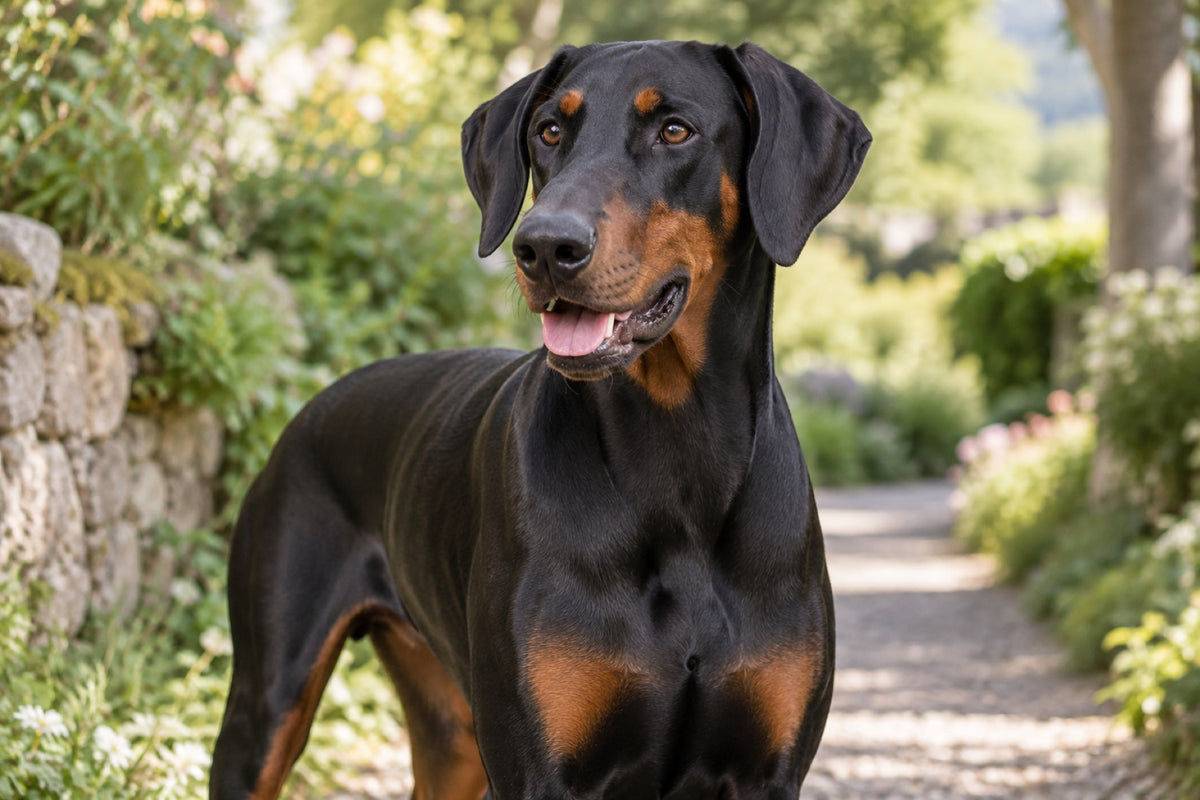
The Doberman has an image problem that has nothing to do with his nature. In films he is the guard dog at the fence, in real life he is a strikingly sensitive, people-oriented dog who copes badly with being left alone. The real issue with this breed is a different one, and it is far too rarely discussed openly when buying a puppy: his health.
Breed profile
- Origin: Apolda, Thuringia, bred as a protection dog by the tax collector Karl Friedrich Louis Dobermann
- Size: males 68 to 72 cm, females 63 to 68 cm, 32 to 45 kg
- Coat: short, hard, close-lying, black or brown with rust-red markings
- Life expectancy: 10 to 12 years, often less in practice
- Temperament: sensitive, attentive, eager to learn, strongly people-oriented, not very independent
Temperament: more sensitive than his reputation allows
Anyone who knows a Doberman wonders about his image. He is not a hard dog but a fine one. He reacts to moods in the household, picks up on tone of voice and body language precisely and quickly becomes unsettled when rules keep changing. A loud commanding tone gets you nothing with him except tension.
At the same time he is extremely attached to his people. The nickname Velcro dog is no accident: he follows you into the bathroom, lies down at the door when you are on the phone and really suffers when he is alone for hours. Being left alone therefore has to be built up patiently from the start, otherwise separation stress develops that is hard to reduce again.
He was bred at the end of the 19th century by a tax collector who needed a dog to protect him on his rounds. This past is still in the breed today: he alerts, he watches, he stands in front of his family. What he is not is a dog who decides on his own. He seeks guidance and waits for it.
Five points that count before buying a puppy
1. The heart disease DCM is the biggest issue
Dilated cardiomyopathy makes the heart muscle slacken so that it pumps less and less well. In the Doberman it is exceptionally common: a long-term study by veterinary cardiology at LMU Munich with 775 evaluated examinations found a cumulative prevalence of 58.2 percent over the dog's lifetime. The course is what makes it treacherous. The disease stays without visible symptoms for a long time, and some of the affected dogs die of sudden cardiac death before anyone has noticed anything at all. Reputable breed clubs therefore require annual heart ultrasound and long-term ECG examinations of breeding animals. Ask the breeder specifically about these findings, not just about the paperwork.
2. Other breed-typical diseases
Von Willebrand disease is a hereditary clotting disorder for which a genetic test exists. Wobbler syndrome affects the cervical spine and leads to gait disorders. Added to that are hip dysplasia, underactive thyroid and, because of the deep chest, an increased risk of gastric torsion. Surgery insurance is not a consideration with this breed but basic equipment.
3. Cropped ears are banned in Germany
The image of the Doberman with pointed, upright ears and a short tail comes from a time when both were amputated. Cropping ears and docking the tail is banned in Germany under the Animal Welfare Act. A Doberman bred in Germany has drop ears and a long tail, and that is how it should be. Anyone who comes across online offers with cropped puppies should stay away: these are imports from countries without a corresponding ban, usually without any health testing.
4. He is on the breed list in some federal states
Dog regulations are a matter for the federal states, differ greatly and are changed again and again. In some states the Doberman is listed, in others not. Depending on the regulation, a temperament test, proof of expertise, lead or muzzle requirements or an official permit may be added, in some cases also higher premiums for dog liability insurance. Clarify the current legal situation for your place of residence before buying, not afterwards, and don't rely on forum posts but ask the local regulatory office.
5. He is not a dog for full-time workers without a plan
A Doberman who lies alone in the flat for eight hours on weekdays does not become calmer but more restless. Because of his close bond, he is one of the breeds in which separation stress occurs especially often. Anyone who wants to keep him needs either a home where rarely everyone is out at the same time, or reliable care. A systematically built-up training to be left alone is not an add-on with this breed but a must.
Care: what he really needs
- Calm, clear leadership. Reliable rules instead of volume. He becomes unsettled by inconsistency faster than sturdier breeds.
- Brain and body work. Obedience, tracking, companion dog training or cycling alongside for the adult dog.
- Closeness to the family. He belongs in the house, not in a kennel. Anything else makes him unbalanced.
- Annual heart check. From about three years, heart ultrasound and long-term ECG, even if he seems healthy.
- Warmth in winter. The short coat without a notable undercoat gives poor protection. In frost he needs a coat, and that is not silly.
Who is the Doberman right for?
For people with dog experience who are looking for an attentive, eager-to-learn partner and have time to really accompany him. For households where someone is there most of the time. And for owners who are ready to deal seriously with the health issue instead of pushing it away: regular heart checks, savings, good insurance.
Not for first-time dog owners without guidance, not for full-time workers without a care solution, and not for people who want a guard dog without relationship work. Anyone looking for a similarly watchful but sturdier dog will find the Rottweiler or the German Shepherd the closer choice.
If at this point you realise the decision is bigger than a breed description, Welcher Hund passt WIRKLICH zu dir? (Which dog REALLY suits you?) holds the questions that come before the breed: time budget, living situation, costs, emergency plan.
Frequently asked questions
Is the Doberman dangerous? A well-socialised and well-led Doberman is a balanced family dog. Training, socialisation and care are decisive, not the breed alone. Because of his size and strength he still belongs in experienced hands.
Why does a German Doberman look different from the one in the films? Because ears and tail may no longer be cropped. Drop ears and a long tail are the natural, legally required condition, not a breeding flaw.
How do I recognise a good breeder? He shows you the heart findings of both parent animals without being asked, lets you see the mother with the puppies and asks you more questions than you ask him. Anyone who dodges the subject of DCM is the wrong one.
And on the portrait?
The clear silhouette, the short glossy coat and the rust-red markings above the eyes make the Doberman a rewarding subject for minimalist portraits. Make sure to photograph him from the front or slightly at an angle in daylight: with very dark fur, a phone camera indoors quickly loses all detail. Our photo tips show how to avoid that.

Dark, short fur loses all texture on cheap paper. On canvas the sheen over the shoulders stays visible. How it will look in the end you can see in the free preview before anything is printed.
Further reading
- Boxer: Eternal Young Dog with a High Cancer Risk: similarly sensitive, a different health issue
- Rottweiler: Listed Breed and 45 Kilos of Responsibility: when it can be sturdier
- Teaching a Dog to Be Left Alone: the most important exercise of all for a Velcro dog
Source for DCM prevalence: Wess G. et al., Prevalence of dilated cardiomyopathy in Doberman Pinschers in various age groups, Journal of Veterinary Internal Medicine 2010;24:533 to 538, summarised by veterinary cardiology at LMU Munich. Retrieved on 19.09.2026.
The links to our books are affiliate links. If you buy through them, you support us at no extra cost to you.


