
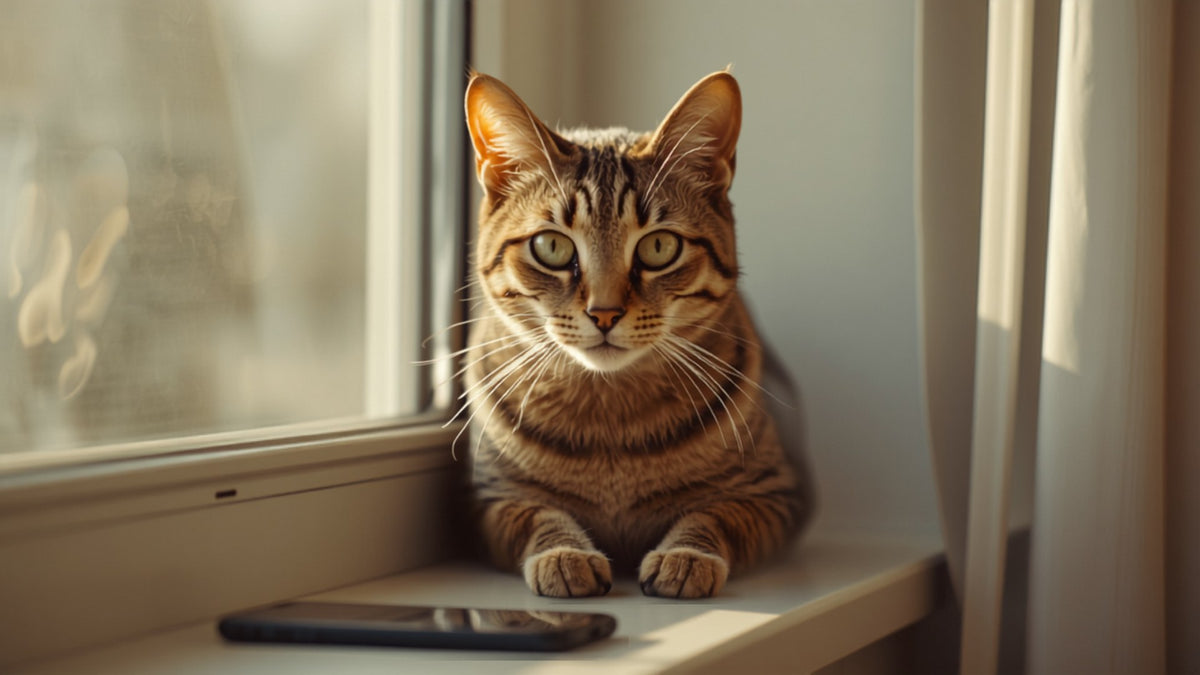
Anyone who has ever tried to photograph a cat knows the sequence: she sits perfectly in the light, you fetch your phone, she gets up. You wait, she lies down with her back to you. You make a sound, she looks at you as if you had insulted her, and leaves. And yet every cat person has that one photo in mind that they would love to have on the wall.
The good news: cats can be photographed. Just not the way you do it with dogs. Here is what works with cats, and works consistently.
Rule number one: You do not go to the cat. The cat comes to you.
A cat who is chased hides. A cat who is ignored comes to have a look. Sit on the floor with your phone, in a spot where she likes to be, and do something else. Read, scroll, drink coffee. In most cases she will be near you after ten minutes, and then you have a window of time.
The best time of day
Cats have two phases in which they can be photographed: the half hour after waking up, when they groom themselves at length and stay seated while doing so, and the late afternoon, when they use the sun at the window. Both are moments with little movement and lots of expression. The worst time is the evening, when the wild five minutes arrive.
Light: the window is your studio
Cat eyes are the heart of every portrait, and they need soft light to glow. A window, from the side or at an angle from the front, without direct sun. No flash, ever. Flash turns cat eyes into green headlights and scares her so much that the next session takes weeks. If it is too dark indoors, it is better to wait for another day than to try to rescue the picture with editing.
At eye level, always
Shot from above, every cat looks small and round. From below she looks majestic, and that is exactly what a portrait needs. Lie on the floor if she is lying on the floor. Stand on a chair if she is sitting on the wardrobe. Phone at the height of her eyes, not yours.
The gaze: one sound, once
A soft rustle, a short hiss, the crinkle of the treat bag, right next to the camera. Cats respond with ears forward and a focused look, and that is the photo. But: the trick works exactly once or twice. After that the sound is found out. So set the focus first, then the sound, then press the shutter. In that order.
Focus on the eyes
Tap on the eye that is closer to you and wait until the phone has focused. With light-eyed cats, blue, copper, green, it all comes down to exactly this point. Burst mode helps: hold your finger down, ten pictures in two seconds, take the best one.
Background: calm, but not sterile
The scratching post with the frayed bits, the windowsill with knick-knacks, it all distracts. A wall, a curtain, a blanket. If the cat is sitting in her favourite cardboard box: fine, that has character. For a portrait from us the background does not matter in the end, we redesign it. But a calm background makes it easier for you to spot the good picture.
What you should avoid
- Chasing. Every step behind her costs you trust.
- Holding her for the photo. You can see it. Stressed cats have flat ears and dilated pupils.
- Zooming. Digital zoom eats the detail in the fur. Better to wait until she is closer.
- Filters. Your phone's beauty filters turn fur texture into a blur. For a portrait we need the original.

Which photo works for a portrait?
Face sharp, eyes open, whole head in the frame, light from the front or the side. The rest is expression. The strongest cat portraits often come from photos where the cat looks slightly annoyed. That is her nature. It is exactly what you want on the wall.
If you are unsure whether your photo is good enough: send it to us, we will tell you honestly what can be made of it, and you get a free preview before printing. And if your cat flatly refuses: there is always another afternoon with sun at the window.
And once you have that one picture that catches her gaze: on acrylic glass light cat eyes glow the most, on canvas the fur looks softer. Both are on offer in the cat portraits, along with posters and wooden frames.
Keep reading
- Taking dog photos yourself: the same rules, a different animal
- Giving a pet portrait as a gift: what the photo can become afterwards
- Ragdoll: the gentle giant: why some breeds are easier to photograph


