

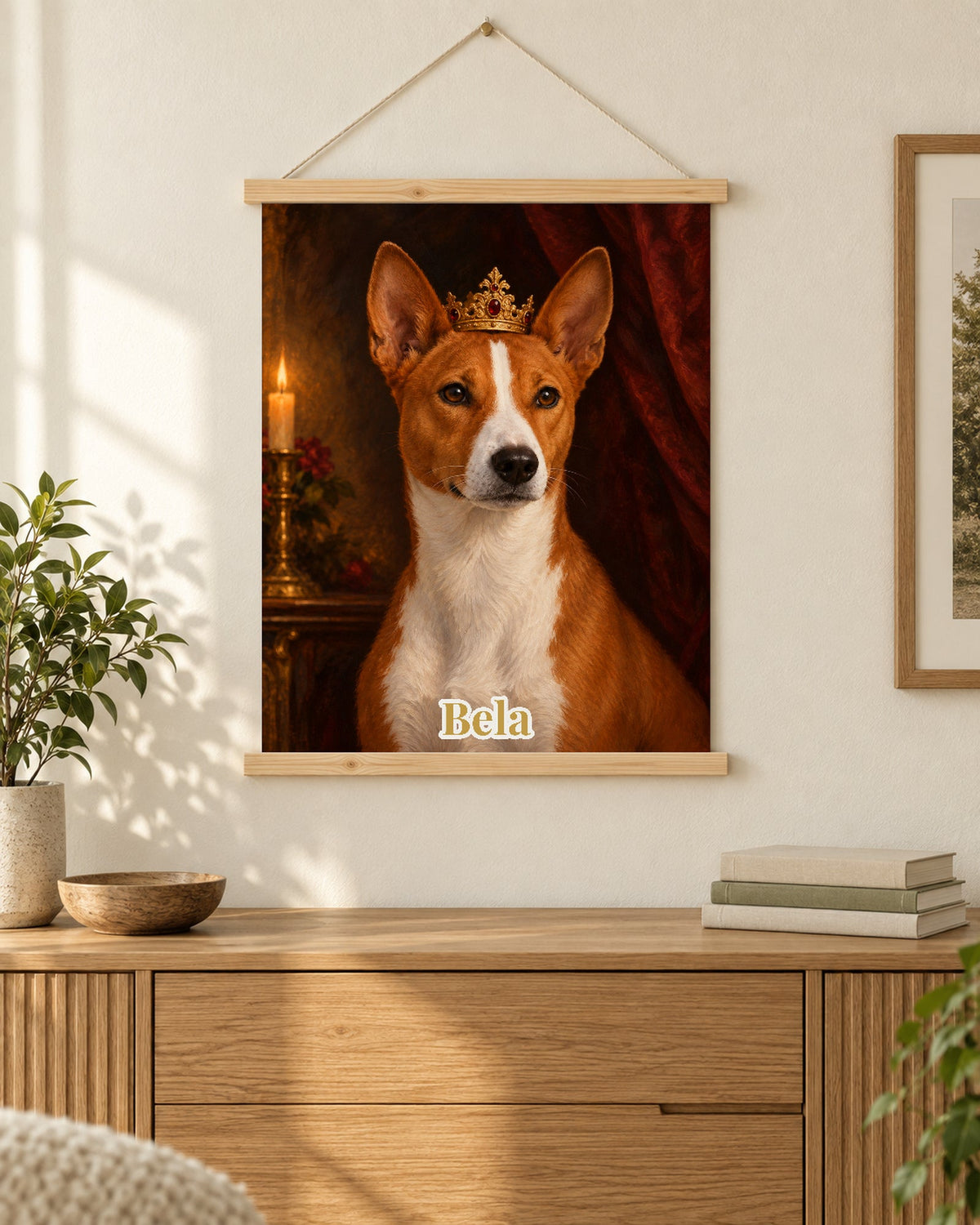
Barking is not in their repertoire, but silence is not either. The FCI standard describes the Basenji’s voice as a mixture of chortling and yodelling. Add forehead wrinkles when the ears prick up and a tail tightly curled over the back: a dog who differs from many people’s expectations.
| FCI | Group 5 (Spitz and primitive types), Section 6 Primitive type, Standard No. 43, without working trial |
|---|---|
| Country of origin | Central Africa (patronage Great Britain) |
| Height at the withers | Ideal males 43 cm, females 40 cm |
| Weight | Ideal males 11 kg, females 9,5 kg |
| Life expectancy | Median 12,1 years in a British analysis of 584.734 dogs, only 92 Basenjis (McMillan et al. 2024) |
| Coat | Short, close-fitting and very fine |
| Colours according to the standard | Black and white, red and white, black with tan and white, black, tan and white, brindle (red base with black stripes); white on feet, chest and tail tip |
From Central Africa via Great Britain
The standard names Central Africa as the origin, with British patronage. The roles are hunting dog and companion. The build is light and long-legged, with gazelle-like grace, as the standard puts it. The same FCI group includes the Shiba, a similarly independent primitive-type dog with a curled tail.
Clean, clever and independent-minded
Remarkably clean in every respect, intelligent, independent yet affectionate and alert, sometimes reserved with strangers: that is the standard’s description. In daily life, they consider whether a cue is worth responding to. Rewards, short exercises and humour get you further than repetition.
Running is their element
The standard calls for quick, long-reaching and tireless movement. Long outings, sprints in secure areas or coursing provide activity. Hunting instincts make off-lead exercise a gamble, so a high, secure fence is essential. The short, fine coat takes little care but offers little protection from cold.
Seasonal offspring
Unlike most dogs, the Basenji breeds seasonally. An analysis of 5.796 Australian pedigree records confirmed the usual local breeding season from May to July; only 12,5 per cent of litters fell outside it (Gardner et al. 2025).
Kidneys, blood and genetic tests
The best-known inherited disease is Fanconi syndrome, a renal tubular disorder in which sugar, amino acids and phosphate are lost in urine. In a US survey, 96 of 959 Basenjis were affected, or 10 per cent, half between four and eight years old (Noonan and Kay 1990). Its late onset meant breeding selection alone could not eliminate it. A 2024 study found a FAN1 deletion almost completely matching disease status in 78 Basenjis examined (Farias et al. 2024). A genetic test for pyruvate kinase deficiency, a recessively inherited anaemia, has been available since 1995 (Whitney and Lothrop 1995). Ask for both parents’ results. The profile’s 12,1 years rests on only 30 deaths.
A good partner if
You want a quiet, clean, sporty dog, find independence charming and provide daily exercise and mental activity.
Better avoided if
You expect absolute obedience, small pets roam freely in the home or the garden is not escape-proof. The dog usually wins that contest.

To see whether an independent primitive-type dog like the Basenji fits your everyday life, try the breed quiz, with more in our book “Welcher Hund passt WIRKLICH zu dir?” (book in German). For the early days with a puppy, there is the free Puppy Starter Pack. Find a picture of your Basenji among our dog portraits, for example as a poster in a wooden frame.
Further reading
- Siberian Husky: why so many reach shelters at two years old
- Puppy biting: teaching bite inhibition without spoiling the fun
- Leaving your dog alone: learning without drama, step by step
Sources, accessed on 20.10.2026: FCI-Standard Nr. 43 Basenji (fci.be, English version dated 06.10.2026; no German version has been published); Noonan CH, Kay JM, Prevalence and geographic distribution of Fanconi syndrome in Basenjis in the United States, Journal of the American Veterinary Medical Association 1990; Farias FHG et al., FAN1 Deletion Variant in Basenji Dogs with Fanconi Syndrome, Genes 2024; Whitney KM, Lothrop CD, Genetic test for pyruvate kinase deficiency of Basenjis, Journal of the American Veterinary Medical Association 1995; Gardner C et al., Non-seasonal breeding appears dominant with incomplete penetrance in Australian Basenji dogs, Scientific Reports 2025; McMillan KM et al., Longevity of companion dog breeds: those at risk from early death, Scientific Reports 2024.
The links to our books are affiliate links. Buying through them supports us at no extra cost to you.


